Top Blockchain Technology Trends to Watch in 2025 - What Businesses Should Know
Introduction:
In this era of coded trust, the future of blockchain technology is no longer a distant view. What started as a niche experiment for cryptocurrencies has now entered mainstream conversations, with enterprises moving beyond proof-of-concepts to rolling out real-world blockchain applications for business in finance, supply chain, and healthcare.
At the same time, emerging Web3 trends 2025, such as decentralised identity and cross-chain interoperability, are rewriting the norms of how businesses and users interact in the digital economy. With momentum building, 2025 signals a turning point for blockchain adoption across industries.
Breakthrough ideas like real-world asset tokenisation and sustainable, eco-friendly protocols are pushing blockchain to evolve into a dominant force that redefines value, trust, and data flow across borders.
As the world marches deeper towards the Web3 landscape, blockchain becomes an inevitable engine of this progress, powering the next phase of digital evolution.
In this blog, instead of just predictions, we’ll go through the top blockchain technology trends of 2025 and share how organisations can prepare for the future of blockchain adoption in enterprise.
The State of Blockchain Adoption in Enterprises by End - 2024
By the end of 2024, blockchain adoption in enterprise had shifted from a mere theory to serious discussions. A Deloitte survey showed that 83% of executives see compelling blockchain use cases for business, and about 31% had already gone beyond pilots into early deployments. Deloitte Report
Wipro’s numbers tell a similar story - around 28% of enterprises had already chosen their first blockchain providers, while 42% are at the exploration stage, searching for the right use cases of blockchain technology for their operations. Wipro Report
And despite ongoing hurdles like high integration costs, regulatory uncertainty, and the pain of working with older systems, companies continued to hold on to blockchain firmly. A recent poll also revealed that 87% of businesses are planning to invest in blockchain technology solutions in the next 12 months. (Deloitte Report)
The banking sector leaned on blockchain for cross-border payments and trade finance. Similarly, supply chain for real-time tracking and traceability, and healthcare for secure patient data sharing and drug verification. Hence, by late 2024, the blockchain applications had already moved beyond being a “nice-to-explore” concept and established itself as a “must-watch technology” shaping the long-awaited reality.
And this shift is what makes 2025 a turning point - a year where blockchain moves from small-scale trials to large-scale, tangible industry-wide adoption. Moreover, the real question now isn’t “if blockchain will matter”, but “how big a role it will play” in the Web3 future.
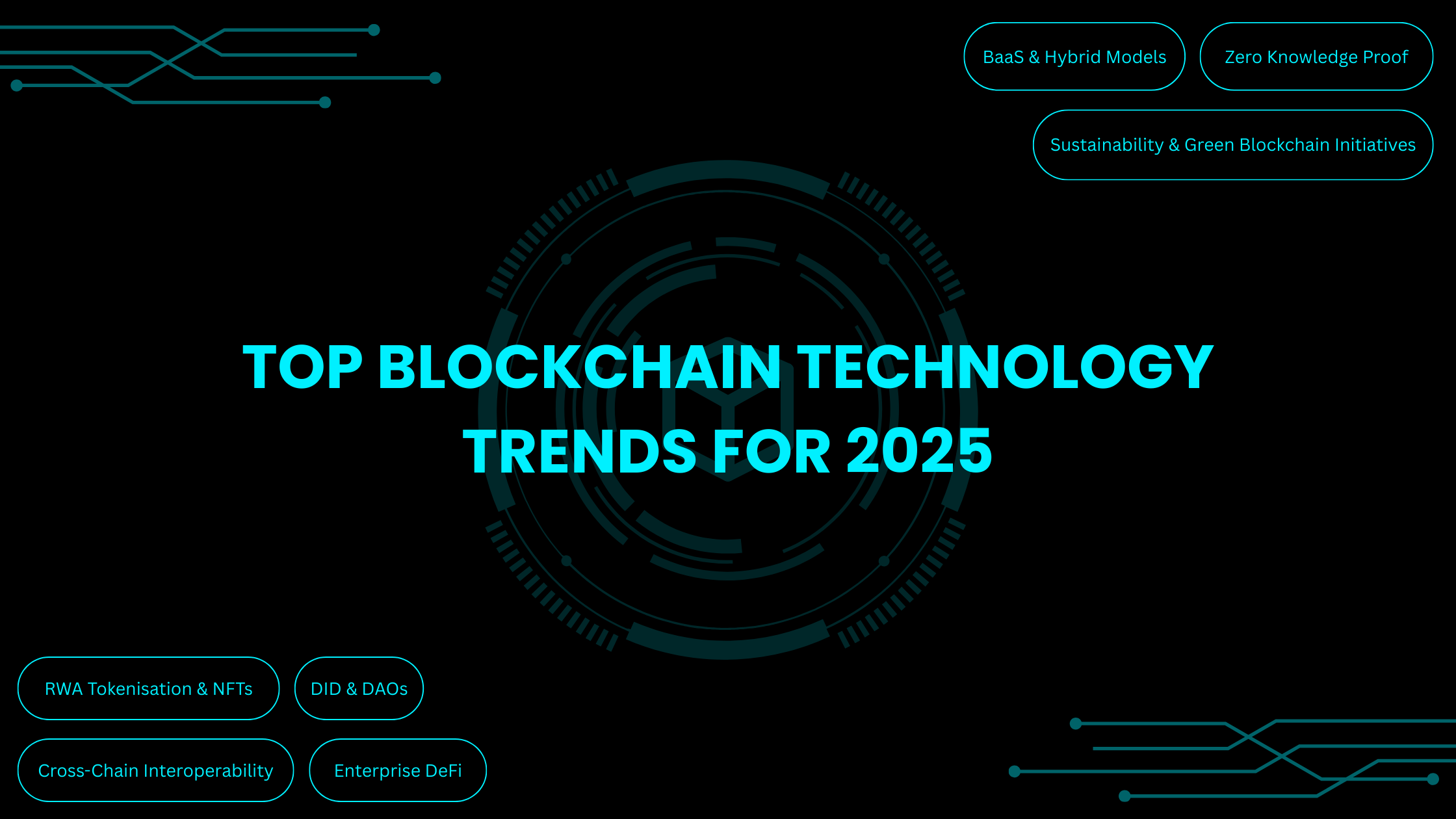
Top Blockchain Technology Trends for 2025
So now that we’ve set the baseline, let’s talk about where blockchain technology trends are actually headed in 2025. The pace of blockchain adoption in enterprises is only getting stronger. For instance, J.P. Morgan’s Onyx platform has expanded its blockchain-based settlement network, while Walmart and IBM’s Food Trust continue to use blockchain applications for business in supply chain tracking. Governments like Singapore are experimenting with institutional DeFi through its Project Guardian initiative.
Some of these Web3 trends are brand new and fast-moving, while others have been around for a while but are finally finding their place. Let’s break down the blockchain trends of 2025 to keep an eye on.
Cross-Chain Interoperability - A Key Blockchain Trend in 2025:
One of the biggest problems with blockchain today is that most of them are standalone networks. Bitcoin doesn’t talk to Ethereum, and private enterprise blockchains don’t easily connect with public ones. That is why in 2025, cross-chain interoperability is no longer optional but a real priority.
Projects like Polkadot, Cosmos, and LayerZero are building the bridges that let different blockchains talk to each other. On the other hand, frameworks like Hyperledger Cacti give companies the tools to connect private and public networks without losing control.
But why does this matter? Because no business wants to be locked into a single ecosystem. If data and digital assets can move smoothly across chains, that’s when blockchain becomes truly useful for enterprises - whether it’s payments, supply chain visibility, or multi-platform integrations.
However, the main challenge here is that every network comes with its own set of rules, and making them work together isn’t easy. Still, interoperability is one of the most important blockchain technology trends of 2025 to watch closely - because that’s exactly what businesses are looking for.
Enterprise DeFi & The “Financialization of Everything”
DeFi (Decentralised Finance) was once looked up as an alien concept and sounded like something only crypto traders cared about. But at present, enterprises are stepping in and exploring what DeFi can do for them - from smart contracts for trade finance, to stablecoins that ease out cross-border payments, and tokenised assets like bonds and securities.
Big names like J.P. Morgan’s Onyx platform have already been experimenting with blockchain-based settlement systems. Similarly, Singapore’s project Guardian is running trials of institutional DeFi under regulatory supervision. Even governments are joining in and exploring tokenised green bonds as a new way to finance sustainable projects.
The reason enterprise DeFi deserves attention is the automation and transparency it brings into finance. That opens the door to faster transactions at lower costs, which is why it’s seen as a key blockchain technology trend in 2025. But scaling this in a regulated environment isn’t a cakewalk. Compliance, risk management, and regulations will decide how far the enterprise DeFi adoption can really go in 2025.
Real-World Asset Tokenisation (RWA) & NFTs Beyond Art
For years, NFTs were boxed into the world of collectibles - profile pictures, digital art, and speculative hype. However, this year has changed the narrative. NFTs aren’t just about digital collectibles anymore, but as digital “titles/keys” or “proof of ownership” that can apply to almost anything of value.
This new way of looking into NFT is where real-world asset tokenisation comes into the picture, which indeed makes it the most powerful blockchain applications for business. Corresponding to this, one of the big shifts we are seeing now is that real estate, supply chain goods, intellectual property, and even carbon credits are being turned into digital tokens on the blockchain.
“Value is no longer tied only to paperwork or physical records.”
Assets that were once illiquid, paperwork-heavy, and slow to trade are now becoming easier to sell, transparent, trackable, simpler to audit, and can even be split into smaller, more accessible portions. No paperwork. No delays. No middlemen.
Some of the most influential voices in global finance are behind this blockchain trend. Larry Fink, CEO of BlackRock, has called tokenization “the next generation of markets.” In line with that, many pilot projects are already underway, such as tokenized real estate projects in Europe, diamond tracking on blockchain to verify authenticity, and even early experiments in tokenized bonds.
Though the blockchain for RWA tokenisation trend is going strong on all levels, the main hurdle is ownership regulation. Who legally owns a tokenised share of a building or bond will remain a big question. Until regulations provide clear answers, adoption of tokenisation projects will mostly happen in controlled settings like consortiums or sandboxes.
Nevertheless, the NFT path is evolving into ‘digital proof systems’ that make assets more liquid, transparent, and accessible. As more businesses are experimenting with physical asset tokenisation, it has eventually emerged as a notable blockchain trend of 2025.
Privacy, Security & Zero-Knowledge Proofs (ZK Tech)
Enterprises love the transparency that blockchain gives, but they hate exposing sensitive data. That’s where Zero-Knowledge Proofs (ZKPs) come in. ZK tech lets you prove something is true (like your age, identity, or a financial transaction) without revealing all the details.
This turns out to be a sweet spot for industries like finance, healthcare, and identity management. Polygon zkEVM and StarkWare are leading the way with ZK solutions, while enterprises are exploring them as a secure, compliance-friendly way to share data.
But the catch here is that ZK Tech is super complex. It leans heavily on advanced math and takes a lot of computing power, which makes scaling a no easy job.
Despite the challenges, for businesses that need both privacy and trust, it’s turning into one of the most talked-about blockchain technology trends of 2025.
Blockchain-as-a-Service (BaaS) & Hybrid Models
Not every business wants to build a blockchain from scratch. That’s why BaaS and hybrid/consortium blockchains are gaining popularity. Cloud giants like AWS, Microsoft Azure, and IBM now offer Blockchain-as-a-Service solutions, so companies can set up blockchain networks without all the heavy lifting.
For enterprises, the appeal is clear - faster setup, lower costs, and easier integration with existing systems. Hybrid or consortium models add to the appeal by letting businesses keep things semi-private while still sharing trusted data with selected partners.
The downside is less decentralization, which takes away some of blockchain’s original essence. But for companies that care more about speed, compliance, and cost-efficiency, it’s a trade-off they’re happy to make.
Decentralised Identity, DAOs & Governance Models
The way identity works online is broken, but blockchain is stepping in for the rescue. At present, decentralised Identity (DID) solutions are becoming more mainstream, allowing users to control their personal data instead of relying on centralized platforms.
For example, Microsoft’s ION project and startups like Civic are helping bring decentralized identity to life. DID is starting to solve some everyday headaches for business, making onboarding quicker, transactions safer, reducing fraud risks, and providing smoother customer interaction.
At the same time, DAOs (Decentralised Autonomous Organisations) are redefining the idea of how communities and even companies make decisions in the Web3 governance model. Instead of relying on traditional hierarchies, they use tokens and smart contracts to bring more transparency and inclusivity into the processes.
Perhaps, DAOs face struggles with legal recognition, and DIDs aren’t fully interoperable yet. Even so, the path forward is obvious - blockchain governance and identity are both heading toward decentralisation, making it the most impactful blockchain technology trends of 2025.
Sustainability & Green Blockchain Initiatives
Energy consumption has always been a controversial part of blockchain. But in 2025, the push for sustainable blockchain solutions is stronger than ever. Besides, Ethereum’s shift to proof-of-stake consensus proved to the world that greener blockchain models are possible, setting the stage for other networks to adopt energy-efficient, carbon-offset, sustainability-focused designs.
Enterprises are more inclined towards green blockchains because of ESG (Environmental, Social, and Governance) requirements, to stay compliant and protect their reputation. Sustainability isn’t just a nice bonus anymore; it’s becoming one of the main reasons for blockchain adoption, especially in areas like supply chain and finance.
Although going green with blockchain isn’t simple, it often means giving up some decentralisation and speed. At the same time, with pressure from regulators and investors, sustainable blockchain adoption is no longer a choice but the only way forward.
What These Blockchain Technology Trends of 2025 Mean for Business
To put it all together, 2025 is the year blockchain stops being just ideas on paper and starts becoming real-world applications for businesses. Blockchain trends like interoperability, enterprise DeFi, tokenisation, decentralised identity, and eco-friendly blockchains aren’t happening in isolation anymore - they’re starting to connect and work together.
And if these trends manage to tackle the big challenges around cost, trust, and regulations, then 2025 could be the year blockchain technology becomes an indisputable force in the Web3 evolution.
How Businesses Should Prepare for Blockchain Trends of 2025
If you’re running a business, then there is no point in waiting for blockchain to arrive at your doorstep, as it’s already here in the market. The smartest move you can make now is to get ahead of the game and prepare for adoption. Here are a few ways to do it;
Start Small, Then Grow - Test blockchain in smaller processes like tracking products in a supply chain, automating payments, or testing digital identity. After seeing measurable results, gradually expand into broader use cases.
Choose What Fits Your Needs - Not every business needs the same blockchain setup. Private, public, and hybrid blockchains each have their own pros and cons. Many enterprises prefer hybrid models, as they balance control with collaboration.
Build with Compliance at the Core - Keep compliance in mind from day one, whether it’s ESG rules, financial regulations, or data privacy laws. This way, you can avoid costly adjustments later as regulations continue to tighten.
Think Multi-Chain, Not One-Chain - The future of blockchain isn’t about locking into a single network. An ideal blockchain solution should connect and ‘talk’ to multiple networks and existing systems. Henceforth, the future is multi-chain and not one-chain.
Conclusion:
The blockchain technology trends of 2025 show that blockchain is no longer experimental; it’s essential. It has become the anchor of the Web3 revolution, forming the base for decentralisation, financial freedom, and a transparent digital ecosystem. Businesses are moving beyond adoption to building new revenue streams, customer experiences, and industry models with blockchain applications.
From cross-border payments to digital identity, finance to logistics to healthcare, industries are using blockchain to solve inefficiencies and set new global standards for trust and security. Hence, the top priority for companies now isn’t if blockchain matters, but how quickly they can implement it. Those who act fast will lead the Web3 era, while late adopters risk being left behind.
While it enables an inclusive and borderless economy, the challenges around regulations, cost, and technical complexity aren’t going away anytime soon. Yet, blockchain technology is becoming an undeniable and reliable part of everyday business.